Genetics Regulates Fetal Development
Massive information has been generated from ongoing research in field of genetics. Consequently, today we know the structure of normal human genome and many inherited disorders.
Inherited recessive, dominant and sex linked genes determine the mode of transmission of various characters to the fetus. Progression and transformation of a single fertilized cell in to a baby is intricate and vast.
Human genome is comprised of thousands of genes; the current known number is twenty-five thousand.
Genes
Genes are very tiny structures located on the chromosome of the cell nucleus. They are the packets of our inheritance codes; not visible by any form of microscopy.
Genes carry the instruction brochure for each cell, describing their function in the body, and they accomplishes its own functions in the body through specific proteins. Any alteration in protein structure or sequence can result in genetically mediated diseases and birth defects.
Each cell in the body has a pair of each gene. Only the gametes (reproductive cells: sperms and ovum) have a single copy of genes. Thereby, a baby gets one copy of genes from each of her parent to form her own inheritance map, Genome, by Mendel’s Law of inheritance.
Where are genes located?
As the baby evolves from a single cell, the zygote (fertilized egg), each new cell formed gets a pair of genes. In cell, genes are packed together, in a definite sequence of proteins, on a two stranded spiral structure, the chromosome.
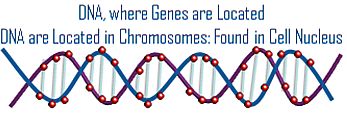
Chromosomes
The chromosome is a single piece of coiled DNA (deoxyribonucleic acid). It contains precisely only those genes that a child inherits from the parents.
Like genes, chromosomes are also arranged in pairs in the nucleus of cells: Each cell has 23 pairs, which amount to total of 46 chromosomes. Only one of the 23 pairs of chromosomes attributes to pair of sex chromosomes (XX/XY). The remaining 22 pairs are called autosomal chromosomes.
Except for the male sex chromosome (XY), the two chromosomes that form a pair coincide in their characteristics; such as size, shape and heredity.
However, the gametes (reproductive cells: sperms and ovum) do not have chromosomes in pairs, but only a single set as seen in case of genes. Reduction in total number of chromosomes of a cell is achieved by cell division process known as Meiosis division.
The moment ovum and sperm unite, the fertilized egg (zygote) so formed again has 46 chromosomes arranged as 23 pairs. A child thus inherits one copy of each chromosome pair from each of her parent: The hereditary blueprint for child’s health and development is thereby passed on unchanged from generation to generation.
Zygote, the fertilized ovum
At conception, fertilization of ovum by sperm forms a single cell known as "zygote". The zygote divides, multiplies and differentiates in to millions of cells that form various organ systems and structures of our body. This intricate progression and vast transformation towards fetal development is regulated by genes inherited.
So, is it surprising that many babies are born with birth defects?
The prevalence of birth defects ranges from 2.5 - 6 percent of live born babies. Most birth defects are identifiable in the neonates, but some may get detected only later as the infant grows.
Effects of genes on child health
Gene injury
Gene damage and mutations are the leading cause of early abortions. Genetic abnormalities in aborted product of conception are noted in more than half of abortions that occur within the first 3 months of pregnancy.
Childhood morbidity and mortality
It has been noted that almost 50 percent of infants and children who need frequent hospitalization suffer from ailment attributable to an underlying genetic defect or predisposition.
Basis of evolution of identical twin fetuses
During the first 3 to 5 days, zygote undergoes mitotic divisions giving rise to identical omnipotent daughter cells. One of the daughter cells may accidentally get separate from rest of the group before they get compacted together. The separated cell does not die nor the remaining cells suffer any damage.
Mitosis generated daughter cells of zygote have equal potential to evolve in to a normal baby. Consequently, two identical groups of cells get formed with identical genetic potential to evolve into a normal human baby.
Result is that a pair of identical twins are formed.
The identical twins originate from different daughter cells of the same zygote. They are therefore also called mono-zygotic twins. The genetic make up of mono-zygotic pair of twins is absolutely identical.
Estimated rate of prevalence of identical twins is believed to be low all over the world; approximately 3 in every 1000 births.
Various ways in which genes are expressed
Dominant-recessive form of genetic endowment
This implies that In a pair of genes, one member dominates over the other. Consequently, only the physical characteristics and resulting traits of the gene that dominates in the pair are expressed.
What is a dominant gene?
Gene is called dominant when it has more potential to express itself as physical characteristics of a child. Its influence on the biochemical and physiological functions of the body are also prominently noticeable. It masks the effect of its partner in the gene pair.
What is a recessive gene?
Recessive gene is a less powerful gene. If in gene pair it is paired with a dominant gene, Its capacity to express itself in the physical, physiological and biochemical traits of the child.
What is co-dominance inheritance?
It is also known as incomplete dominance in gene expression. Here both the partners of a gene pair that have differences in their coding are expressed completely. In such mode of inheritance neither of the gene partner in the pair dominate over each other, for example; genetic representation for blood group AB.
Co-dominance form of inheritance can also be seen in cases where when one gene in the pair is dominant and has a higher potential to express itself, but fails to mask all the expressions of its partner. This is the genetic representation of sickle-cell anemia.
What is the meaning of genetic imprinting?
Normally every gene pair has one gene from each parent. As an effect of genomic imprinting one of the parents’ genes heritability potential is biochemically silenced. Consequently, in the child only one parent’s genes are expressed wether they are dominant or recessive.
Polygenic mode of inheritance
As the name suggests, in this form of inheritance many genes contribute to the noticeable expression of inheritance, for example; height, weight, intelligence, skin color, temperamental attributes, susceptibility to cancer and so on.
Sex linked Inheritance
It is the expression of genes that are located on the sex chromosomes. With the advanced knowledge of genome and mode of inheritance, there have been advancements in prenatal genetics screening for evaluation of zygote and if required gene therapy. This forms a major step towards prevention of genetically related chronic disabilities in children.
Related pages of interest
Genetic Disorders, a child health challenge
Prenatal & Newborn Screening Help Avoid Lifelong Disabilities
Preimplantation Diagnosis of IVF Baby
Gene Therapy Corrects Defective Genes
Liked what you read just now? Pay it forward!
Can't find answer to your concern? Search the site!


Subscribe
 Child Health Blog Feeds


Free E-zine


Follow Me
Related Pages
Chrmosome and Genes
Modes of Gene Expression
Meiosis and Mitosis
Monozygotic Twins
Modes of Gene Expression
Incidence
Genetic Mutations
Single Gene Disorders
Multifactorial Disorders
Chromosomal Disorders
Prenatal Screening
Types of Genetic Screening
Indications
Quadruple Screen Test
Alpha-Fetoprotein
Amniocentesis
Chorionic villus sampling
Preimplantation genetic diagnosis
Blastomere Biopsy
Risk of Mosaicism: Why?
Possible Flaws in Diagnosis
Vectors Used
Principle in safety
Germline modification therapy
Somatic cells gene therapy
Cons of Gene therapy
Embryonic and Adult Stem Cells
Application of Stem Cells
Liked What You Just Read?
Pay It Forward!



New! Comments
Have your say about what you just read! Leave me a comment in the box below.